Not to worry, we’re here to help. If you’re a Kiwi residential or small commercial property owner, this blog is here to help you navigate what you need to know, jargon-free.
Why Concrete Driveway Regulations Matter
Concrete driveway regulations can be a little bit complex, because while driveways are technically additions to your private property, they can also overlap with public infrastructure like footpaths, kerbs and stormwater systems.
Even though it’s going on your property and you have a lot of flexibility because of that, your concrete driveway does need to meet your local council rules and national building standards. Knowing what those regulations are can help prevent issues in the future, such as incurring fines, property damage, or even the removal of the driveway by your local council (though this is rare).
You’re only required to know these regulations very well if you are going to be DIY-ing your driveway. If you are partnering with a team, you may be responsible for obtaining consent as the property owner, but your driveway layers will help guide you through the required process. Speaking of which…
Do You Need a Consent?
For anyone planning on a new driveway, this is the big question! The golden rule in New Zealand is that if the work can affect public land or infrastructure, you’ll probably need a building or resource consent. While most residential driveways on private land don’t usually require building consent (as per the Building Code Schedule 1 exemptions), things change when:
- That driveway connects to a public road.
- The driveway needs modifications to a kerb or channel.
- The slope or drainage impacts public footpaths or stormwater systems.
Your local council will have unique concrete driveway regulations. For example, the Auckland Council, which is in the region in which we operate, needs property owners to supply a Vehicle Crossing Application before any work affecting the footpath or kerb starts.
The best thing to do is twofold: partner with a driveway construction team that knows what is required, and double-check your property’s unique concrete driveway regulations on your local council’s website.
A snapshot of the most important concrete driveway regulations:
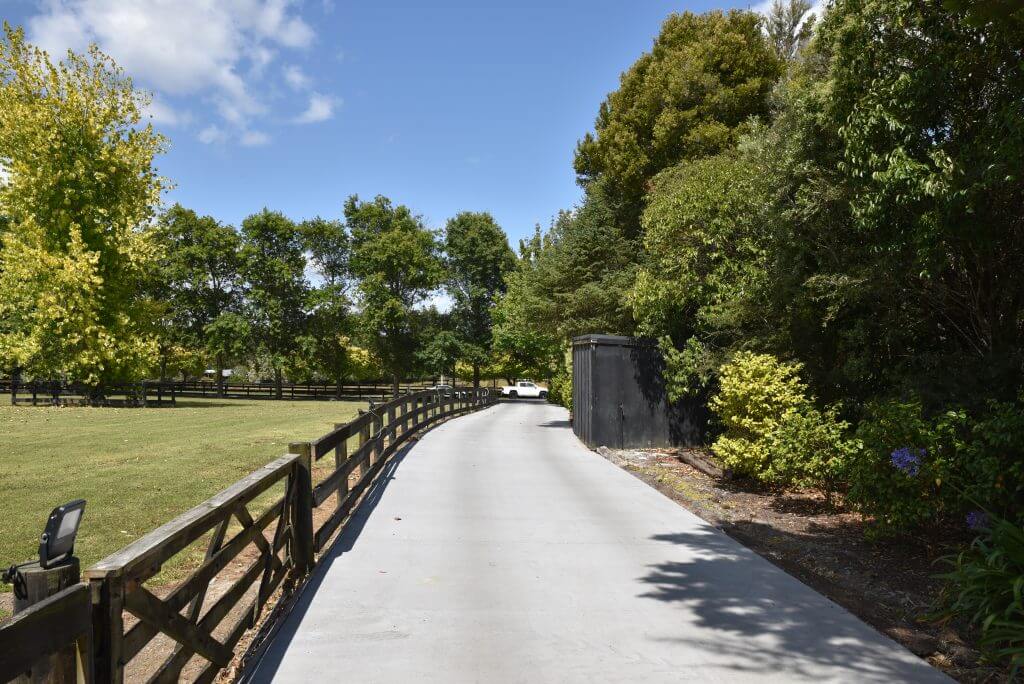
- Width. The standard width for residential driveways is typically 2.5 to 3 metres. For commercial use or shared driveways, this could increase to 3.5 metres or more.
- Gradient. Driveway slope should not exceed 1:5 for safety and accessibility, though councils may vary on this. Cross-falls (the slope across the driveway) should be around 2% for water runoff.
- Surface. NZS 3604:2011 and NZS 3114:1987 provide guidance on materials and surface finishes. Concrete should be reinforced and finished with a non-slip texture.
- Stormwater management. Your driveway must not direct stormwater onto public roads or neighbouring properties. Some councils require channels or soak pits.
As you can see, things can get a little complex quite quickly. Your driveway can have an impact on the well-being and safety of the kerbs and roads it connects to, so it’s important to take the whole process one step at a time.
What Does This Mean For You?
Now, we’ve seen it all in our time, and these concrete driveway regulations help to not only avoid fines, but also to avoid all sorts of pitfalls from poor construction. You don’t need to be a civil engineer to get your driveway right, but it does help to follow sound advice and find people who know exactly what they’re doing. Case in point:
- Start with your local council. Their driveway or vehicle crossing guidelines are the ones that matter, so become closely acquainted with them or partner with a local team that already is.
- Consider the state of your property. Concrete driveway regulations have a lot to say about grade and slope, so these should be carefully factored into your vision for your driveway.
- Don’t forget about consents. Acquiring consents can extend the timeline of your project, so make sure to kick off the consents process as early as possible if your property requires one.
Now that you have a grip on the fundamental concrete driveway regulations that can impact your new (or refreshed) driveway, you’re equipped to get started.
When in doubt, the best thing you can do is reach out to a team of professional concrete driveway installers to assess your property directly. This will give you some insights into which regulations impact your project and which ones you don’t have to worry about.
Navigate NZ’s concrete driveway regulations with Asphalt & Civil.
We’re the trusted name for all concrete and asphalt work in Auckland, and we know concrete driveway regulations like the back of our hands. Homeowner, business owner, property owner; whoever you are, we can help.
Get in touch for a free quote on your regulation concrete driveway today.